How Policy Design Becomes Routine Practice
Policy implementation depends on clear guidance, named responsibilities and workable everyday processes, helping a designed rule become consistent public service.
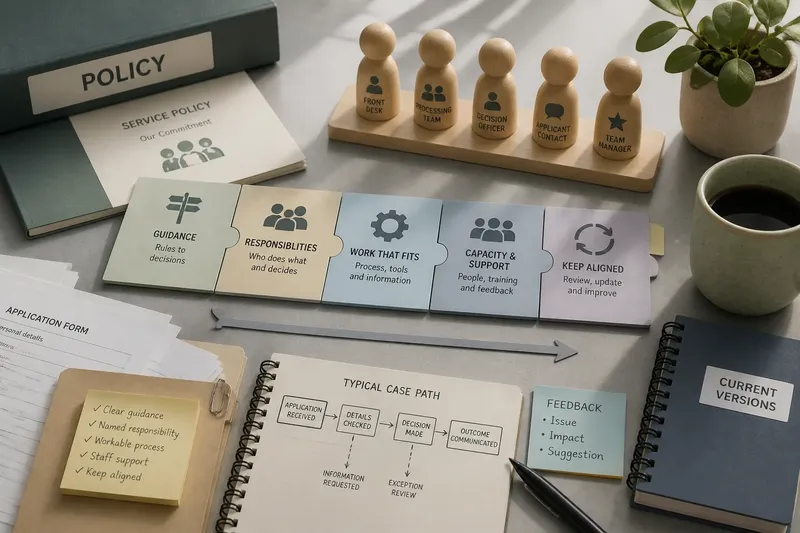
The most common mistake in policy implementation is treating formal approval as the finish line. A policy may state what should happen, yet leave staff unsure who acts, what information to use or how to handle an unusual case; the cost is uneven service and avoidable delay. The handoff from policy design to routine practice is where those choices need to become usable.
From rule to routine
A policy sets an authorised direction: for example, a new entitlement, restriction or service standard. Implementation is the work of turning that direction into decisions and actions that recur in offices, call centres, schools or local services. A routine is not merely a written procedure; it is the pattern people can follow under ordinary working conditions.
This distinction matters because policy documents often describe aims more clearly than operations. “Provide timely support” communicates intent, but does not tell a caseworker which form to accept, a manager how to assign incoming work or a resident how to correct missing information.
The handoff is therefore not a single meeting or document. It is a set of connected arrangements: guidance, authority, information, staff capability and feedback. A gap in any one can make a sound design difficult to apply consistently.
Guidance for decisions
Good operational guidance translates broad rules into decision points without pretending every case is identical. It should identify the relevant condition, the evidence staff may consider, the available action and what to do when the facts do not fit the usual pattern.
For instance, a service policy might allow applications through an online form or in person. Guidance can explain how staff record either route in the same case system, what to do when a document is unavailable and how to tell the applicant what happens next. That makes the policy legible to both staff and the public.
Guidance also needs a clear status. Staff should be able to distinguish binding requirements from recommended practice and local discretion. If an instruction is mandatory, say so; if a judgement is allowed, describe its boundaries and how a decision should be recorded.
Use plain language, but do not remove the conditions that matter. A short decision tree, annotated form or worked scenario may clarify a rule more effectively than a long narrative, particularly when staff need to consult it during a busy shift.
Named responsibility
Implementation becomes fragile when responsibility is described only in collective terms. “The department will review applications” can conceal several handoffs: who receives the application, who checks eligibility, who approves an exception and who tells the applicant the outcome?
Assigning responsibility does not mean giving one person control over every task. It means making each transition visible, including who owns the work while it waits and who can resolve a blockage. A responsibility map can show the distinction between the person doing a task, the role authorised to decide and the team that must be consulted.
Say a council introduces a revised housing-support application. In this invented situation, the front desk receives forms, a processing team checks required details and a designated officer decides cases that fall outside the standard criteria. If the guidance also names who contacts applicants about missing information, staff can direct each case without leaving it in an ambiguous queue.
Keep the map aligned with actual roles and cover arrangements. A policy that depends on one specialist without a substitute may stall during leave, while a decision assigned to a team with no delegated authority may simply be passed onwards.
Work that fits
A process can be clear on paper and still clash with the tools or conditions staff use. Check whether forms collect information that the decision requires, whether the case system can record the relevant outcome and whether staff can see the guidance at the point of use.
Consider the whole path, not only the central decision. Residents may submit information through a website, by post or at a service counter; staff may then enter it into a shared system, request clarification and issue a response. If each channel produces a different record, later teams may have to reconstruct what happened.
Workload and timing also shape routines. A process requiring a specialist review should make clear how urgent cases are identified and what staff do while a review is pending. Otherwise, a sensible safeguard can turn into an unexplained hold that residents and colleagues cannot interpret.
Before a procedure becomes standard, trace a typical case from arrival to outcome and mark every handoff. The aim is to expose missing information, unclear ownership and duplicate work—not to assume that a diagram alone fixes them.
Capacity and support
Staff need more than access to a policy document. They may need training on a changed decision, time to practise a new form, a route for asking questions and a manager who can interpret recurring uncertainty. These supports should match the complexity of the work rather than treating every change as a brief announcement.
Capacity includes the practical resources needed to carry out the routine. A new reporting duty may require access to a shared database; a revised referral process may depend on another service accepting the information in a usable format. When those dependencies are outside the implementing team, name them and agree how issues will be raised.
Staff feedback is particularly useful when it identifies a specific point of friction: a field that does not match the rule, a letter that prompts repeated questions or an approval route that sends cases in circles. A named contact and a simple method for logging such issues can turn informal workarounds into issues that responsible managers can address.
Keeping practice aligned
Once a routine begins, versions matter. If a policy changes but an old template remains in circulation, staff can follow different instructions while believing they are following the same one. Give guidance and forms clear owners, dates of revision and a visible place where current versions can be found.
Review the routine when its assumptions change: a new service channel, a revised eligibility rule, a different data system or a recurring kind of exception may alter what staff need to do. The purpose is not constant rewriting; it is to notice when operational instructions no longer match the authorised policy.
Keep a record of decisions that require judgement, especially where the policy allows discretion. This helps managers see whether similar circumstances are being treated consistently and whether staff need clearer guidance. The record should capture the reason for the decision, not merely the outcome.
Questions in practice?
What belongs in operational guidance?
Include the decision criteria, evidence to consider, available actions, escalation route and instructions for communicating the result. Separate mandatory rules from recommended practice so staff can tell where judgement is permitted.
Who should own a handoff?
Name the role responsible for moving the case to its next stage and the role that can resolve a stalled or disputed transition. A handoff is clearer when the sending and receiving teams know what information must travel with it.
How can managers spot unclear routines?
Listen for repeated questions, conflicting workarounds, incomplete records and cases that repeatedly return to an earlier stage. These signs point to a specific instruction, tool or responsibility that may need clarification.
When should guidance be revised?
Revisit it when the formal rule, system, service channel or pattern of exceptions changes enough to affect staff decisions. Keep the current version easy to identify, and tell the affected roles what has changed.
Make the handoff usable
A policy becomes routine when people can connect its authority to a clear decision, a responsible role and a workable next action. Those connections should be visible in the guidance, tools and records staff actually use, not left to memory or informal custom.
For policy implementation, the useful final check is simple: can a staff member explain what to do with an ordinary case, where to take an exception and how the person affected will hear what happens? If any answer depends on guesswork, the handoff still needs attention.